How to Choose the Right Fanuc Industrial Robots for Your Business?
Choosing the right Fanuc industrial robots for your business is crucial. According to a report by the International Federation of Robotics, industrial robot installations have surged globally, reaching a record of over three million units by 2021. Fanuc, a leader in automation, accounts for a significant portion of this growth. Their robots enhance efficiency across various sectors, including automotive and electronics.
Manufacturers must consider factors like payload capacity and speed when selecting Fanuc industrial robots. The right choice can lead to improved production rates and reduced operational costs. Research shows that organizations adopting robotics can boost productivity by as much as 30%. However, businesses often struggle with integration and cost assessments. This highlights the need for a careful evaluation of specific operational needs.
With technological advancements, Fanuc industrial robots are becoming more versatile. The integration of AI and machine learning enhances their capabilities. Yet, navigating these options can be complex. Inadequate understanding of these technologies can lead to suboptimal investments. Therefore, a thorough assessment of these robotic solutions is essential for long-term success.

Choosing the Right Fanuc Robots: Understanding Your Business Needs
Choosing the right industrial robots requires a clear understanding of your business needs. Start by assessing your production processes. What tasks do you need to automate? Consider speed, precision, and payload. Each function demands different robot specifications. It’s crucial to map these requirements carefully.
Evaluate your team’s skill level. Do you have experts in robotics? If not, consider user-friendly options. Training may add complexity and time. Reflect on whether your employees can adapt to new technology. Any hesitation can impact productivity and morale.
Also, think about future growth. Your current choice should not just meet today’s needs but accommodate tomorrow’s ambitions. Evaluate market trends in robotics. Are there emerging technologies that could enhance your setup? It’s a balance of meeting immediate needs while planning for scalability.
Evaluating Fanuc Robot Types: Articulated, SCARA, and Collaborative Options
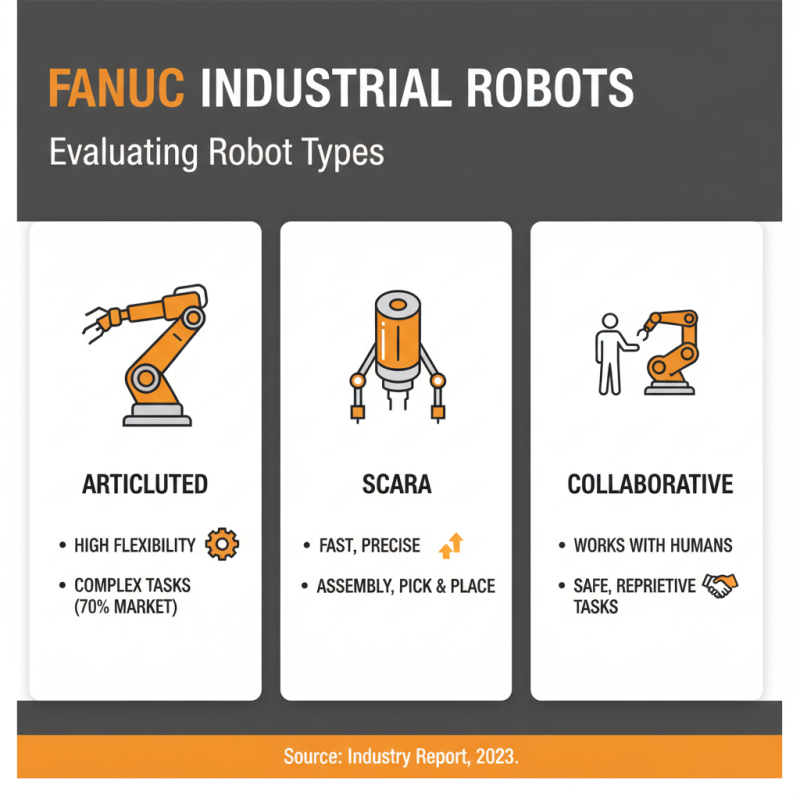
When considering the right Fanuc industrial robots for your business, it's essential to evaluate the different types available. Articulated robots are a popular choice. They provide flexibility and a wide range of motion, making them ideal for complex tasks in manufacturing. According to a recent industry report, articulated robots account for nearly 70% of the total robot market due to their versatility.
SCARA robots are also noteworthy. They excel in tasks that require high speed and precision. Industries often use them for assembly, packaging, and material handling. The latest data indicates that SCARA robots have increased in demand by 25% over the last few years, reflecting their growing significance in automation.
Collaborative robots, or cobots, offer a unique advantage. They can work alongside human operators safely. This burgeoning market is expected to grow significantly, with a projected annual growth rate of 34% by 2025. However, the integration of cobots may present challenges. Organizations must consider how these systems will coexist with traditional operations. Balancing worker safety and productivity remains a key concern in this evolutionary phase of automation.
Assessing Payload Capacity: Matching Fanuc Robots to Your Production Scale
When choosing the right industrial robot, payload capacity is crucial. It defines how much weight a robot can handle efficiently. For factories, this metric shapes production capabilities. According to industry reports, approximately 45% of robot users cite payload as a top consideration. It is vital to align payload specifications with your production needs.
Evaluate your current and future production scales. Some robots can lift up to 500 kg, while others excel at lighter loads. For example, lightweight models serve industries needing agility and speed. More robust systems support heavy lifting in manufacturing and automotive sectors. Understanding your specific application ensures optimal performance.
It's essential to think about the operational environment. A high payload capacity might not justify complexity and cost for smaller tasks. Conversely, underestimating capacity can lead to inefficiencies or equipment failure. Inconsistent payload management can disrupt workflows. Thus, reflect on how payload impacts your overall efficiency and productivity, ensuring you choose wisely.
How to Choose the Right Fanuc Industrial Robots for Your Business? - Assessing Payload Capacity: Matching Fanuc Robots to Your Production Scale
| Robot Model |
Payload Capacity (kg) |
Reach (mm) |
Applications |
Recommended Production Scale |
| Model A |
10 |
1500 |
Assembly, Packaging |
Small Scale |
| Model B |
20 |
1800 |
Welding, Material Handling |
Medium Scale |
| Model C |
30 |
2000 |
Palletizing, Sorting |
Large Scale |
| Model D |
50 |
2200 |
Food Processing, Automotive Assembly |
Very Large Scale |
Analyzing Precision and Speed: Key Metrics for Industrial Automation
When selecting Fanuc industrial robots, precision and speed are critical metrics. Precision affects product quality. A recent report from a leading industry research firm found that 85% of manufacturers cite precision as their top priority. In the competitive landscape of automation, errors can lead to costly rework. Robots that operate within ±0.02 mm precision significantly reduce material waste and improve efficiency.
Speed is equally vital. The same report indicates that robots with a cycle time of under 0.5 seconds can boost production output by 30%. However, speed must be balanced with accuracy. High-speed operations can sometimes sacrifice precision, leading to defects. Analyzing the specific application helps to find this balance.
Tips: Identify your production needs first. Assess not just speed, but the precision required for your products. Test and validate robot capabilities through simulations. Additionally, consider how software integration can enhance precision and speed alignment. A misalignment in these areas could disrupt your entire operation. Addressing these challenges early on will prepare your business for a smoother transition to automation.
Cost-Benefit Analysis: ROI and Life Cycle Considerations for Fanuc Robots
When considering the cost-benefit of industrial robots, it's essential to analyze the return on investment (ROI) and their life cycle. Industrial robots often require a significant upfront investment. However, they can significantly enhance productivity, decreasing long-term costs. Calculating ROI involves comparing these costs against the savings generated through increased efficiency.
The life cycle of an industrial robot is another crucial factor. It typically spans several years, during which maintenance costs may arise. Organizations should plan for these expenses and evaluate the robot’s performance over time. Unexpected breakdowns can lead to production delays, affecting profitability. Therefore, investing in reliable support and maintenance services is crucial.
Not all robots will fit every business perfectly. Specialization needs to be a key consideration, as industries differ vastly. The right choice may vary based on specific production needs and targets. Constantly assessing robot performance and alignment with business goals is essential. Regular reflection on these aspects can help ensure the best use of resources.