How to Choose the Best Industrial Robot Palletizer in 2026?

Choosing the best industrial robot palletizer in 2026 requires more than comparing speeds and payload ratings. A machine may promise 1,200 picks per hour, yet perform differently with dusty bags, unstable cartons, or changing product sizes. Real factory conditions matter. Details matter.

This guide examines the practical factors behind a reliable palletizing decision. We consider payload, reach, cycle time, gripper design, conveyor layout, vision systems, controls, and operator training. A suitable robot should place each case accurately, even during long shifts and frequent product changes. Its software should also communicate smoothly with existing warehouse and production systems. Integration problems can quietly erase expected productivity gains.

Energy use, maintenance access, spare-parts availability, and total ownership cost deserve equal attention. A low purchase price may hide expensive tooling, specialist service, or difficult programming. Safety remains essential, including risk assessment, guarding, emergency stops, and clear access procedures. These requirements should be verified with qualified professionals and current regional standards.

Supplier experience provides useful evidence. Ask for performance data from similar products, pallet patterns, and operating environments. Request a live demonstration when possible. Numbers alone are not enough. A higher payload is not automatically better. Some recommendations remain conditional because every line has different constraints, labor skills, and future plans. This article offers a practical framework, but final selection should follow measured testing, documented requirements, and honest consultation with experienced integrators.

How to Choose the Best Industrial Robot Palletizer in 2026?

Define Payload, Reach, and Takt Time Using IFR’s 541,302-Robot 2023 Baseline

How to Choose the Best Industrial Robot Palletizer in 2026?

Choosing an industrial robot palletizer starts with three measurable constraints: payload, reach, and takt time. The International Federation of Robotics’ World Robotics 2024 report recorded 541,302 industrial robot installations worldwide in 2023. That figure shows strong adoption across manufacturing. It does not make every robot suitable for palletizing. Your line data matters more.

Define payload as the full moving load, not the carton weight alone. Include the gripper, vacuum cups, tooling, and dynamic forces. For example, a 12-kilogram case and a 4-kilogram tool already require 16 kilograms. Add a practical margin, then verify wrist torque. A nominal payload rating can mislead. Reach must cover the pick point, pallet corners, and the highest layer. Model the farthest approach, not the cell center. Leave clearance for slip sheets, guards, and changing pallet heights.

Takt time equals available production time divided by required output. If a conveyor delivers 40 cases per minute, takt is 1.5 seconds per case. Test the complete pattern. Include pickup, rotation, placement, release, and return. IFR’s 2023 installation figure describes adoption, not cycle performance. That distinction is easy to miss. During commissioning, record actual cycle times across full pallets. Reject brochure-only calculations. A first estimate may look excellent, yet fail when cartons shift or suction weakens. An honest allowance for jams and product variation may reduce theoretical throughput, but improves reliability.
Classify 4-Axis, 6-Axis, and Cobot Palletizers Under ISO 10218-1:2025

How to Choose the Best Industrial Robot Palletizer in 2026?

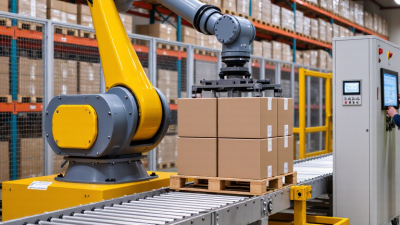
ISO 10218-1:2025 classifies robot safety by function and risk, not simply by axis count. A four-axis palletizer usually delivers fast vertical movement and stable case placement. It suits regular cartons, fixed pallet patterns, and high-throughput lines. Its wrist has limited orientation flexibility. That limitation matters when cartons arrive unevenly.

A six-axis palletizer offers broader movement and precise tool orientation. It handles mixed cases, unusual product shapes, and complex stacking patterns more effectively. However, extra joints increase programming demands, maintenance points, and potential hazards. Practical commissioning evidence shows that reach, payload, stopping distance, and gripper design can matter more than axis count.

Cobot palletizers require careful classification. A cobot is not automatically safe for open access. ISO 10218-1:2025 still requires safeguards, control-system reliability, and risk-based design. Collaborative operation also depends on speed, force, contact conditions, and workplace layout. A low-payload cobot may struggle with tall cartons or unstable loads. That weakness is easy to overlook.

Do not treat compliance as a sticker. Review the complete cell, including conveyors, pallet dispensers, sensors, tooling, and software. Confirm the applicable 2025 requirements with a qualified safety professional and local authority. The best choice is the robot that meets production needs without creating hidden risks.

Mistakes remain possible, especially when product patterns change.

Match Grippers and Pallet Patterns to 30–60 Cases per Minute

How to Choose the Best Industrial Robot Palletizer in 2026?

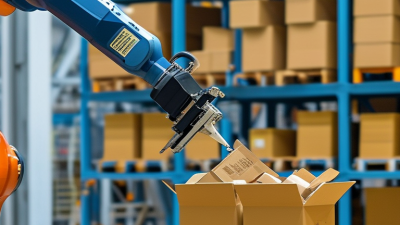
For 30–60 cases per minute, throughput begins with the case, not the robot. Measure carton weight, dimensions, surface texture, and center of gravity. Vacuum grippers suit stable, sealed cartons with smooth surfaces. Mechanical clamps offer better control when cases are dusty, uneven, or slightly damaged. A gripper that works in a showroom may slip during a humid night shift. Test real cartons, including crushed corners and changing fill levels.

Pallet patterns must balance speed, stability, and product protection. Interlocking layers usually resist shifting during transport. Column stacking can be faster, but it may need corner boards or tighter wrapping. At 30 cases per minute, a simple four-case pattern may provide dependable flow. At 60, the same pattern could create unnecessary wrist movement. Simulation helps, yet it is not enough. Check acceleration, approach angles, conveyor spacing, and recovery time after a missed pick. Small delays become large losses.

Tips: Record actual cycle times for one full hour, not only ten test cycles. Leave room for gripper cleaning and carton variation. Ask operators where jams occur. Their observations often reveal problems that software misses. Review noise, guarding, access, and emergency stops before installation. Do not select the fastest arm on paper. Select the complete cell that maintains stable motion and consistent layers. I would also challenge the first pattern approved by the team. It may look efficient, but real pallets can tell a different story.

How to Choose the Best Industrial Robot Palletizer in 2026? - Match Grippers and Pallet Patterns to 30–60 Cases per Minute

Reference selection matrix for carton palletizing applications operating at continuous production rates.

Target Rate Cases per Hour Typical Case Profile Recommended Gripper Configuration Suitable Pallet Pattern Recommended Robot Payload Recommended Robot Reach Key Selection Priority
30 cases/min 1,800 Corrugated cartons, approximately 5–15 kg per case; moderate variation in dimensions. Single-case vacuum or mechanical clamp. A dual-zone vacuum plate can be used when carton surfaces are stable. Column stack, brick pattern, or interlocked 5–6 case layers on a standard pallet footprint. At least 25–50 kg, including the gripper and the heaviest case. Approximately 2.0–2.6 m, depending on conveyor and pallet positions. Flexible product handling, reliable case detection, and simple changeover.
40 cases/min 2,400 Uniform cartons, approximately 8–18 kg per case; consistent packaging and conveyor spacing. Multi-case vacuum plate or two-case clamp to reduce pick-and-place cycles. Brick or pinwheel pattern with 5–8 cases per layer for improved load stability. Approximately 40–80 kg, including tooling, product, and a suitable safety margin. Approximately 2.2–2.8 m for one or two pallet positions. Cycle-time balance, fast tool actuation, and accurate layer placement.
50 cases/min 3,000 Mixed or high-volume cartons, approximately 10–20 kg per case; limited package variation. Four-case vacuum layer gripper or synchronized multi-case clamp, subject to carton strength and surface quality. Interlocked brick, pinwheel, or layer pattern selected to minimize unsupported carton edges. Approximately 60–120 kg, including the gripper and the maximum simultaneous payload. Approximately 2.5–3.1 m, based on pallet spacing and conveyor elevation. High acceleration, low vibration, controlled release, and quick pattern changes.
60 cases/min 3,600 High-throughput, repeatable cartons, generally 10–25 kg per case; stable dimensions are strongly preferred. Multi-case layer gripper, typically vacuum, clamp, or hybrid tooling with independent gripping zones. Optimized interlocked layers, often 6–10 cases per layer, with edge alignment and center-of-mass control. Approximately 80–160 kg, including tooling, product, dynamic loads, and engineering margin. Approximately 2.8–3.4 m, depending on layout, pallet count, and required access. Throughput stability, synchronized infeed, tool rigidity, and minimal recovery time.
Engineering reference: Cases per hour are calculated as cases per minute × 60. Final robot sizing must verify actual case weight, carton compression strength, center of gravity, gripper mass, acceleration forces, conveyor pitch, pallet dimensions, layer height, safety requirements, and the required operating duty cycle. Vacuum gripping should be validated for porous, dusty, coated, or damaged carton surfaces before production approval.

Compare Total Cost, Energy Use, and Uptime with NIST Life-Cycle Methods

How to Choose the Best Industrial Robot Palletizer in 2026?

A palletizer should be measured across its entire service life, not only by purchase price. Use a NIST-aligned life-cycle cost method to define the system boundary, operating period, labor needs, energy use, maintenance, and disposal. Compare equipment using the same pallet patterns, shift schedule, and production volume.

Measure real energy consumption with a temporary power meter during acceleration, idle periods, and full-load cycles. A system drawing 5% less power may still cost more if it creates slower changeovers. Include electricity rates, compressed-air demand, spare parts, technician hours, and training. Small costs accumulate quietly.

Uptime requires evidence, not optimistic sales figures. Track mean time between failures, mean time to repair, blocked conveyors, sensor faults, and changeover delays for at least several weeks. Use production logs, not memory.

Our first estimate ignored restart losses after minor faults, and the projected payback changed noticeably. That mistake was useful.

Build a year-by-year cash-flow model covering installation, commissioning, operation, preventive maintenance, repairs, upgrades, and end-of-life removal. Discount future costs using a documented rate, then test higher energy prices and longer repairs. The cheapest option may fail this test. Review assumptions with operators and maintenance staff, because their practical experience often exposes costs spreadsheets miss.

No model is perfect. That is why sensitivity analysis matters.

Validate Safety, Vision, and Line Integration Against ISO/TS 15066 Data

Choosing the best industrial robot palletizer in 2026 requires more than comparing payload and cycle speed. Safety, vision, and line integration must be tested against ISO/TS 15066 data and the machine’s real operating conditions.

Start with a documented risk assessment. Check pallet weight, gripping force, speed, stopping distance, and access points. ISO/TS 15066 provides biomechanical guidance for collaborative applications, but it does not replace site-specific validation. A palletizer may pass a factory test yet behave differently beside conveyors, stretch wrappers, or manual loading areas. Measure actual stopping distances. Confirm that safety scanners, gates, emergency stops, and restart controls work together. Small timing errors matter.

Vision systems should detect damaged cartons, poor labels, shifting layers, and unexpected objects. Test them under dust, glare, low light, and changing package colors. Line integration also needs practical evidence. Review communication signals, fault recovery, recipe changes, and safe maintenance access. Ask for validation records, test conditions, and operator training details. Do not accept vague claims.

Tips: Use real cartons during trials. Record every stop and false detection. Recheck results after software updates. Keep an honest list of unresolved risks. Perfect data is uncommon. That is exactly why review matters.

How to Choose the Best Industrial Robot Palletizer in 2026?

Validate Safety, Vision, and Line Integration Against ISO/TS 15066 Data

The chart compares representative ISO/TS 15066 Annex A reference values for quasi-static and transient contact forces across selected body regions. Use these values as part of a documented risk assessment, then verify the final palletizer cell through application-specific speed, pressure, force, tooling, vision, guarding, and line-integration tests. The values do not replace the current controlled edition of ISO/TS 15066 or the applicable ISO 10218 requirements.