| Companion Robots |
Social interaction and daily engagement |
Provides conversation, reminders, games, music, emotional check-ins, and basic information access. |
Semi-autonomous; usually relies on voice commands, scheduled routines, and cloud or local software. |
Older adults living alone, children, and families seeking additional social engagement. |
May reduce feelings of isolation, encourage routines, and provide accessible interaction. |
Cannot replace human companionship, professional care, or emergency response services. |
Microphone and camera permissions should be reviewed; users should understand how conversations and recordings are handled. |
| Caregiving and Monitoring Robots |
Wellness support and remote supervision |
Can support check-ins, activity monitoring, medication reminders, video communication, and alerts for unusual events. |
Supervised autonomy; alerts and recommendations generally require human confirmation. |
Older adults, people recovering at home, and families coordinating care from a distance. |
Helps families stay informed between visits and supports more consistent daily routines. |
Sensors may produce false alarms or miss events; it is not a substitute for a trained caregiver or clinician. |
Health-related information needs strong access controls, secure updates, and clear consent from the monitored person. |
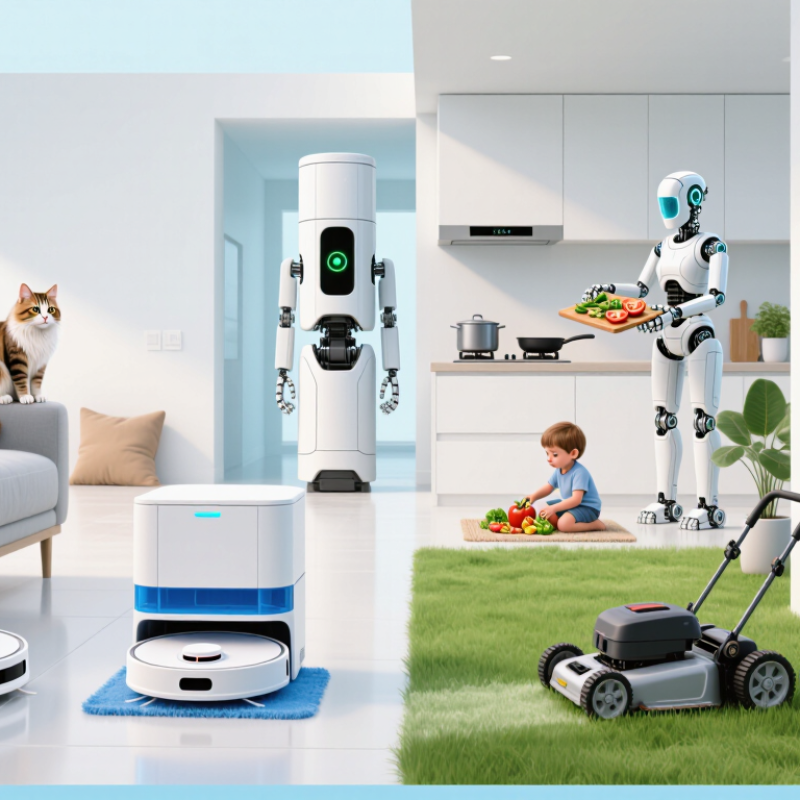
| Domestic Cleaning Robots |
Routine floor and surface cleaning |
Vacuuming, mopping, navigation around furniture, and scheduled cleaning of defined areas. |
Highly autonomous in mapped areas, but still requires maintenance and occasional human intervention. |
Busy households, people with limited mobility, and families with pets or frequent floor mess. |
Reduces repetitive chores and can maintain a regular cleaning schedule. |
May struggle with stairs, clutter, cables, spills, corners, and objects that are not recognized by its sensors. |
Home maps and room data may reveal household routines; physical obstacles and charging areas should be managed safely. |
| Assistive Mobility Robots |
Movement support and navigation |
May help with indoor guidance, object carrying, obstacle awareness, or controlled movement support depending on the design. |
Usually user-controlled or supervised; safe operation requires environmental awareness and human judgment. |
People with mobility limitations and users who need assistance navigating specific home environments. |
Can support independence and reduce the physical effort involved in routine movement or carrying tasks. |
Not every home is accessible; devices may have weight, speed, doorway, stair, or battery constraints. |
Professional assessment, user training, emergency stop functions, and regular maintenance are important. |
| Telepresence Robots |
Remote family connection and oversight |
Enables two-way video communication and, in some designs, remote movement through indoor spaces. |
Primarily remotely controlled, with automated navigation assistance in some environments. |
Families living apart, remote caregivers, and people who need frequent visual check-ins. |
Makes visits more flexible and can support communication when in-person visits are difficult. |
Depends on reliable connectivity and user acceptance; it does not provide physical caregiving. |
Visible status indicators, consent-based access, strong passwords, and defined private zones help protect household privacy. |
| Educational and Child-Support Robots |
Learning, routines, and supervised play |
Offers age-appropriate practice, interactive stories, reminders, language activities, and guided exercises. |
Semi-autonomous and dependent on adult configuration, supervision, and content controls. |
School-age children and families looking for structured supplemental activities. |
Can make practice more interactive and help children follow routines. |
Should supplement, not replace, teachers, parents, childcare, or developmental support professionals. |
Child data protection, parental controls, age-appropriate content, and limited recording are essential. |
| General-Purpose Home Service Robots |
Multi-task household assistance |
May combine basic transport, object recognition, reminders, simple fetching, and task coordination in suitable environments. |
Limited or supervised autonomy; performance depends heavily on home layout and task complexity. |
Households seeking flexible support for repetitive, low-risk tasks. |
Could reduce task switching and provide a single interface for selected household routines. |
Complex manipulation, stairs, fragile objects, crowded rooms, and unexpected situations remain challenging. |
Clear operating boundaries, physical safeguards, software updates, and permission management are required. |