Top 5 Industrial Automation Solutions for Global Buyers?

The world of industrial automation is rapidly evolving. Businesses across various sectors are adopting new technologies. This shift improves efficiency and reduces operational costs. Companies are exploring innovative solutions tailored to their specific needs.

As buyers look for reliable industrial automation solutions, choices can be overwhelming. The market is filled with various products, each claiming to be the best. It can be challenging to distinguish between them. Understanding the latest trends can guide these decisions.

Highlighting the top solutions helps buyers make informed choices. Insights from experienced professionals offer valuable perspectives. However, it’s crucial to always question existing systems. Are they truly meeting your needs? Reflecting on current practices can reveal potential improvements. Embracing industrial automation is a step toward future success.

Top 5 Industrial Automation Solutions for Global Buyers?

Overview of Industrial Automation Solutions for Global Buyers

Industries worldwide are rapidly adopting automation solutions. According to a report by Mordor Intelligence, the industrial automation market is expected to reach $296.7 billion by 2026, growing at a CAGR of 9.5%. This growth illustrates the increasing reliance on automation to enhance operational efficiency and reduce costs. For global buyers, understanding the nuances of these solutions is critical.

One significant element in industrial automation is the integration of IoT (Internet of Things). This technology enables real-time data collection and analysis. Companies can monitor equipment performance with precision. A study from Statista highlights that 70% of enterprises consider IoT essential for their automation strategies. However, the integration process can often be complex and resource-intensive.

Another critical factor is the importance of cybersecurity. As industries modernize, they become more vulnerable to cyber threats. A Cisco report indicates that 53% of organizations experienced a security breach in the past year. Buyers must prioritize secure automation solutions to protect their assets and data. Investing in training and better protocols can significantly decrease these risks.

Top 5 Industrial Automation Solutions for Global Buyers

Solution Type Key Features Application Areas Estimated Cost (USD) Market Trend
Robotic Process Automation (RPA) High efficiency, 24/7 operation, reduces errors Manufacturing, Warehousing, Service 10,000 - 500,000 Growing demand in service automation
Programmable Logic Controllers (PLC) Real-time processing, robust and durable Production lines, Material handling 1,000 - 15,000 Stable growth over the last decade
Industrial Internet of Things (IIoT) Data analytics, remote monitoring, predictive maintenance Smart factories, Energy management 10,000 - 100,000 Rapid adoption in manufacturing sectors
Human-Machine Interface (HMI) User-friendly, visualization tools, alarm management Control rooms, Equipment monitoring 500 - 10,000 Continuous evolution with UI/UX improvements
Manufacturing Execution Systems (MES) Real-time tracking, scheduling, data integration Production management, Quality control 20,000 - 200,000 Increasing emphasis on efficiency and quality

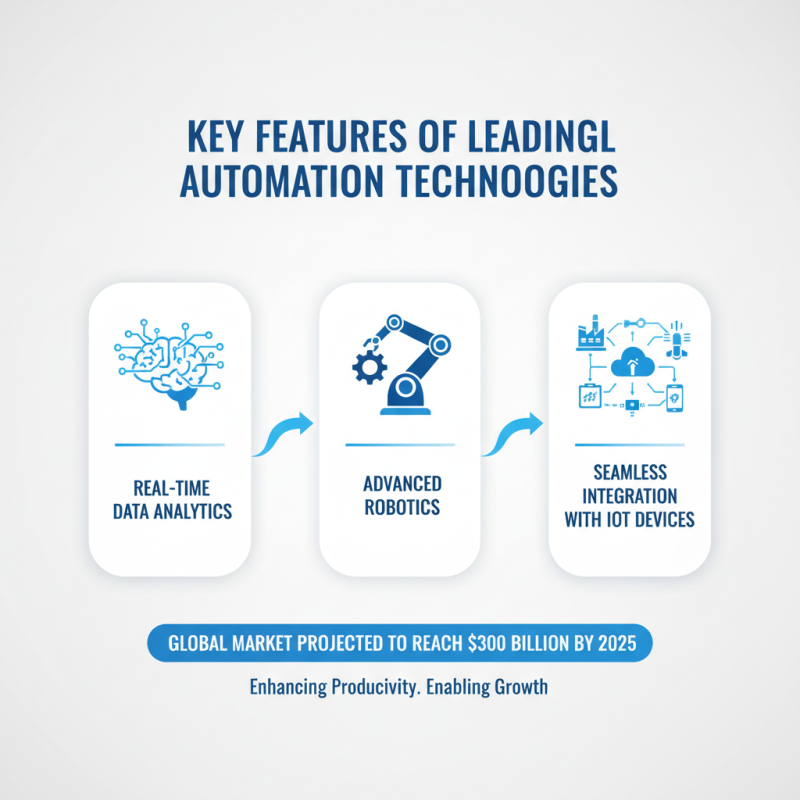
Key Features of Leading Industrial Automation Technologies

Top 5 Industrial Automation Solutions for Global Buyers?

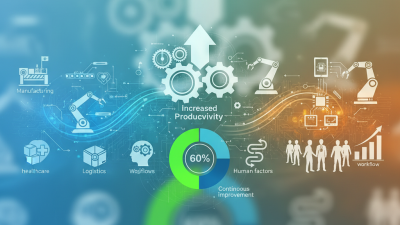
In today's industrial landscape, automation solutions are pivotal for enhancing productivity. The global industrial automation market is projected to reach USD 300 billion by 2025, showcasing rapid growth. Key features of these technologies often include real-time data analytics, advanced robotics, and seamless integration with IoT devices.

Real-time data analytics drives efficiency. By analyzing data instantly, companies can make informed decisions. Reports indicate that organizations using these technologies see a 20% increase in operational efficiency. However, the challenge remains that not all companies effectively utilize data, leading to missed opportunities.

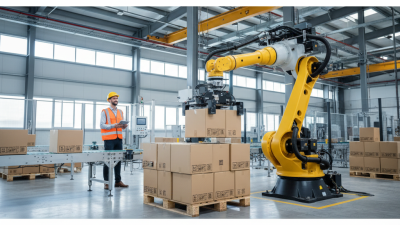
Advanced robotics are transforming operations on the factory floor. Automation reduces human error and operational costs. However, implementation can be complex and requires skilled personnel. Research shows that over 60% of firms face difficulties in adapting to these innovations. Seamless IoT integration enables machines to communicate effectively, but ensures cybersecurity risks must be addressed. Organizations need to balance innovation with robust security measures to protect sensitive data.

Top 5 Industrial Automation Solutions: A Comparative Analysis

The industrial automation landscape is evolving rapidly. Recent reports show that the global market for industrial automation is expected to reach $300 billion by 2026. This growth reflects a shift towards more efficient processes and reduced operational costs. Many companies seek solutions that integrate artificial intelligence (AI) and machine learning (ML) capabilities.

One of the key trends is the increasing demand for programmable logic controllers (PLCs). These devices provide versatility in various industrial applications, adapting easily to different tasks. Yet, their implementation often requires skilled personnel. A workforce gap exists, with only 32% of manufacturers feeling adequately prepared for these technology transitions. This raises questions about investing in automation while cultivating necessary talent.

Cloud computing plays a vital role in industrial automation. It allows for real-time data processing and remote monitoring. According to a study, organizations leveraging cloud solutions can enhance productivity by up to 25%. However, security concerns frequently dampen enthusiasm. Many firms remain hesitant due to fears of data breaches and compliance issues. Balancing innovation with security remains a significant challenge in automation's future trajectory.

Factors Influencing the Selection of Automation Solutions

When selecting industrial automation solutions, several key factors come into play. A recent report from the International Federation of Robotics highlights that nearly 80% of manufacturers prioritize cost efficiency in their automation choices. It’s essential to assess the long-term return on investment. Solutions that appear cheaper upfront may lead to higher operational costs over time.

Another critical aspect is scalability. According to a survey by McKinsey, 65% of businesses prefer automation systems that can be easily scaled. This flexibility allows for adapting to changing production demands without significant additional expenses. When evaluating options, prioritize vendors that provide clarity on scalability.

Tip: Assess your current and future production needs. Ensure that any automation solution can grow with your business.

Finally, consider the integration capabilities of the automation solutions. A lack of compatibility with existing systems can lead to delays. A study from the Automation Research Council noted that 54% of project delays stemmed from integration issues. Investing in well-integrated systems can enhance productivity and reduce frustration.

Tip: Explore user reviews focusing on integration experiences. This can reveal potential pitfalls before you commit.

Future Trends in Industrial Automation and Their Implications

Top 5 Industrial Automation Solutions for Global Buyers?

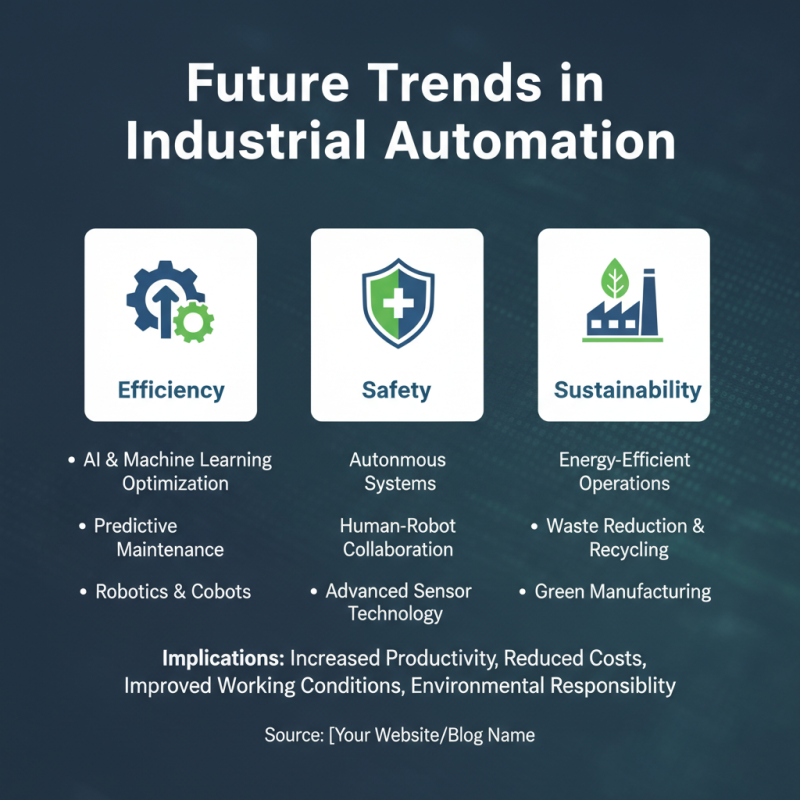
The landscape of industrial automation is rapidly evolving. Future trends promise efficiency, safety, and sustainability. Companies are embracing cutting-edge solutions and rethinking their practices.

In upcoming years, artificial intelligence will lead the way. This technology enhances predictive maintenance and streamlines operations. Machine learning algorithms analyze vast data sets, identifying patterns that inform decision-making. Businesses must prepare for the integration of AI into their systems.

**Tip:** Consider starting small. Pilot projects can minimize risks while showcasing potential improvements.

Another trend is the rise of collaborative robots, or cobots. These machines work alongside humans, maximizing productivity. They’re flexible and adaptable, fitting various tasks without extensive reprogramming. Organizations pursuing automation must evaluate their workforce needs. Not all tasks will suit cobots, so careful selection is crucial.

**Tip:** Engage employees early. Their insights can guide effective integration and acceptance of new technologies.

Sustainability also garners attention in automation. Solutions that reduce energy waste are increasingly favored. Smart automation systems monitor resource usage, enabling more efficient operations. Balancing technology with sustainable practices requires thoughtful consideration and ongoing evaluation.